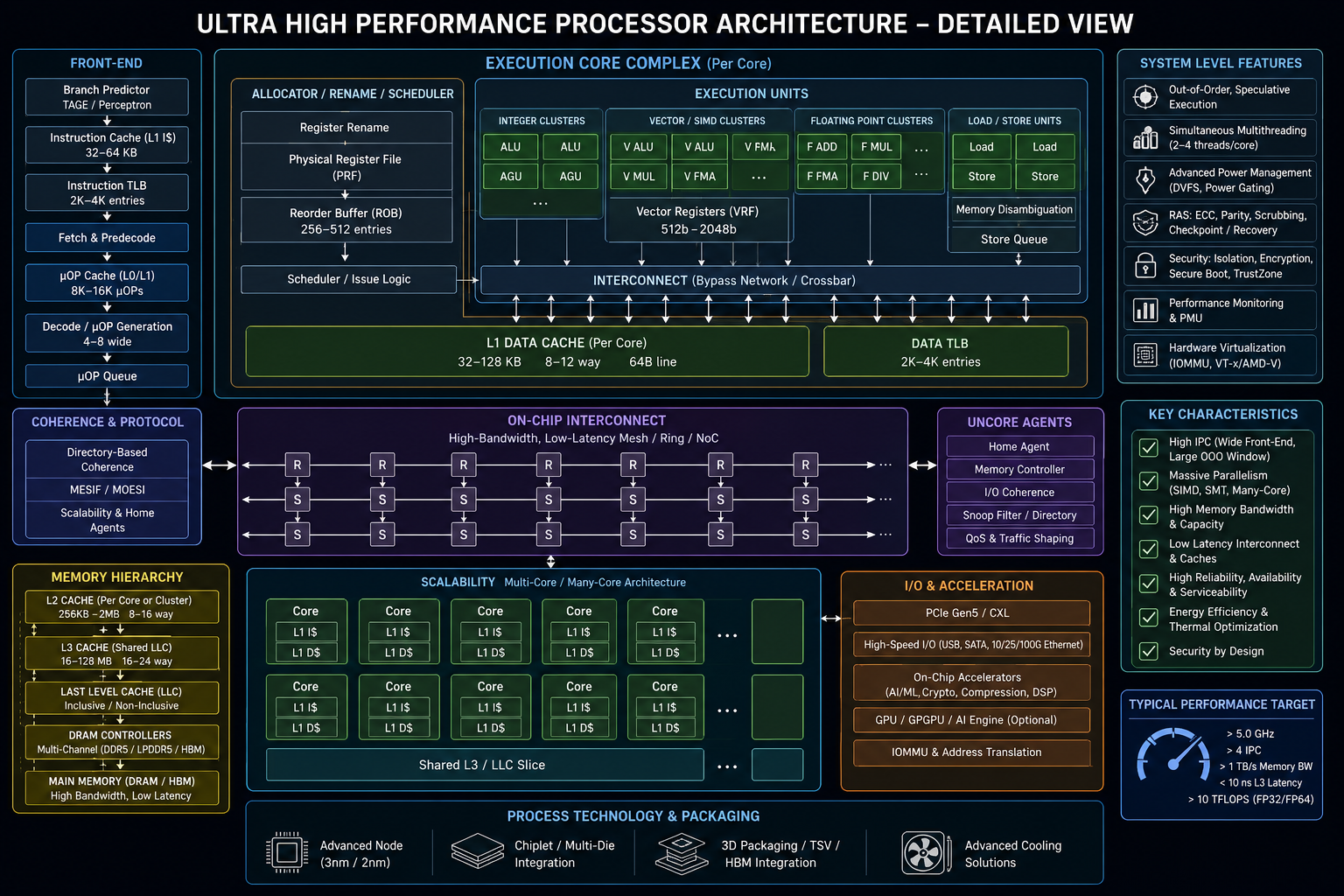
The project addresses two strategic European priorities: Artificial Intelligence (AI) governance and digital sovereignty, focusing on reducing Europe’s dependence on foreign computing technologies. Modern AI systems, particularly large language models and deep learning applications, require enormous computational resources, creating both economic and technological barriers. While specialized accelerators such as GPUs and TPUs dominate AI workloads, there is growing interest in enabling efficient AI execution on general-purpose processors due to their flexibility, availability, and strategic relevance for European technological autonomy.
The proposal investigates the redesign of processor backends to better support emerging AI workloads while preserving the general-purpose nature of CPUs. Experimental analysis conducted on a representative set of deep learning models reveals that the processor backend, particularly the limited availability of vector execution resources, is currently the primary performance bottleneck. Results show that increasing vector processing capability directly improves performance, indicating that contemporary AI applications expose substantial untapped data-level parallelism.
Building on these observations, the project hypothesizes that a modular backend architecture, inspired by the slice-based design of IBM POWER processors, can provide a more scalable and efficient alternative to the monolithic approaches adopted by most current CPU vendors. Such an architecture could improve execution resource utilization, enhance support for diverse data types, facilitate future scaling, and enable advanced optimization techniques such as sparsity-aware computation.
As a continuation of previous research on architectural mechanisms for machine learning workloads, the project aims to generate new knowledge on processor microarchitecture design for AI, contributing both to the scientific understanding of scalable CPU backends and to Europe’s long-term objective of developing sovereign, competitive computing technologies. Successful outcomes could influence future processor designs, support open-hardware initiatives such as RISC-V, and strengthen European capabilities in advanced computing systems.